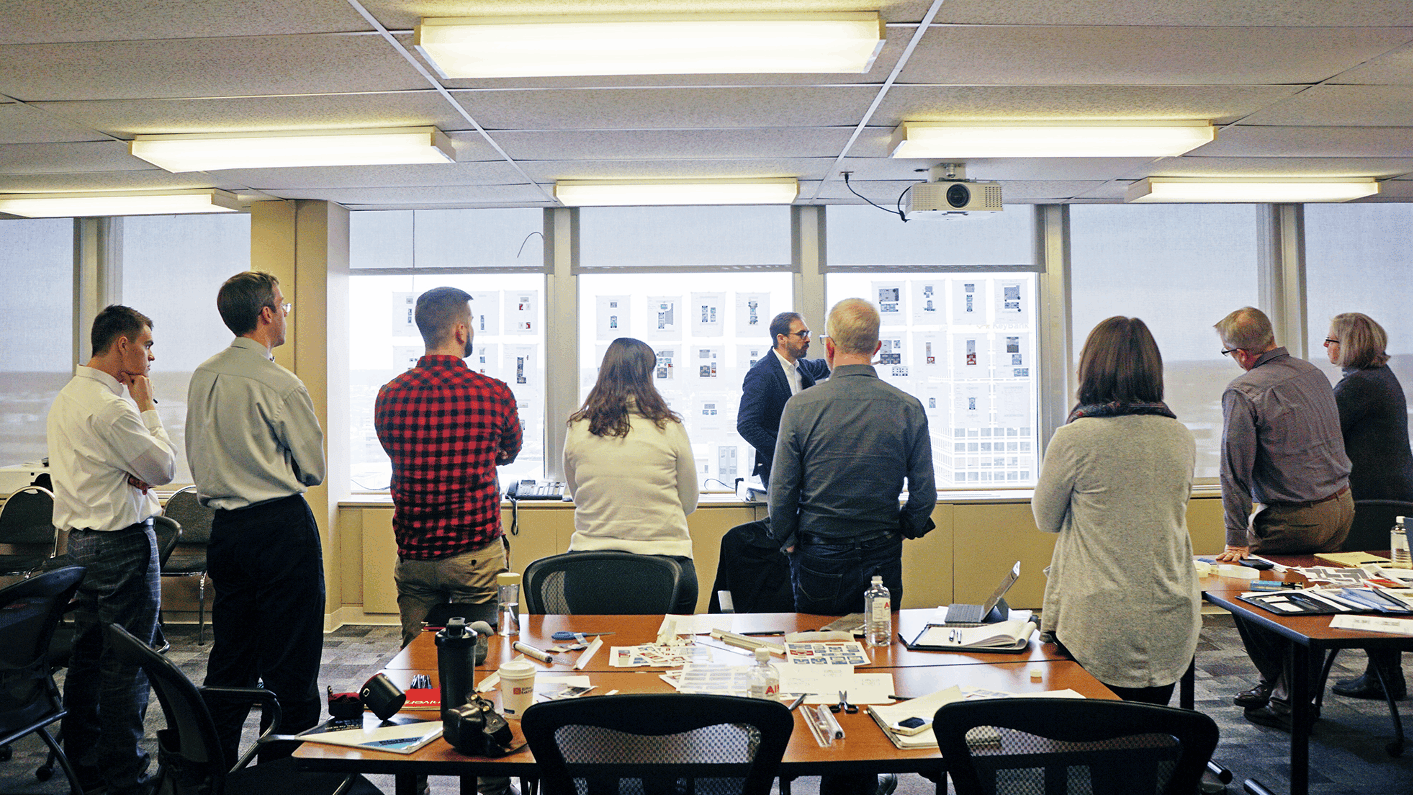
Planners and developers during the 2017 stress test workshop in South Bend
South Bend and others
South Bend: Where the Code Stress Test Began
In 2017, South Bend's zoning code had over 500 permitted land uses and required developers to seek dozens of variances just to build the kind of small-scale housing the city's neighborhoods were originally built with. Pattern Zones Co. founder Matthew Petty designed and facilitated a code stress test through the Incremental Development Alliance: a workshop where city planners role-played as small-scale developers to see what their own code actually allowed. The stress test produced an annotated report with reform recommendations. South Bend's planning team took it from there, leading a comprehensive code rewrite with their own consultants.
The Challenge
South Bend's zoning code was written after the city's housing stock already existed. The traditional building types that defined its neighborhoods were largely illegal to replicate. A developer building infill in the Near Northwest neighborhood needed 36 variances just to put seven houses back where seven houses used to be, at a cost of $12,000 passed directly to homebuyers. The code had over 500 permitted land uses, was last updated in 2004, and embedded suburban assumptions — large lots, deep setbacks — into a city with an urban fabric.
The Approach
Planners, developers, and architects sat down with real South Bend lots and tried to build missing middle housing on them. They created site plans, ran pro formas, and walked through the permitting process step by step. At each step, participants documented where the code broke down: where setbacks didn't match existing lot sizes, where use restrictions blocked housing types the neighborhood already had, where parking requirements made small projects infeasible. The findings were compiled into an annotated report with specific reform recommendations.
What the Stress Test Delivers
The stress test ends with an annotated report, but its real value is what happens in the room. When planners sit down with a hypothetical project on a real lot and discover they can't make their own code work, the case for reform stops being theoretical. In South Bend, Director of Planning Tim Corcoran and his team took those findings and led a comprehensive code reform with their own consultants over the following years. The same diagnostic was applied in Kalamazoo and Overland Park. Each city ran its own process and built its own pre-approved program afterward. Our role began and ended with the stress test itself.
What Followed in South Bend
500 → 65
Land uses consolidated
South Bend's planning team rewrote the code from scratch
2020
New code adopted
The new form-based code took effect January 2020
2022
Pre-approved plans launched
South Bend's team independently developed a program with free plans available to any builder.
“If five planners can't figure out the 'why' of a rule, then it's gotta go, right?”
Tim Corcoran
Director of Planning
City of South Bend
Where the Stress Test Led
- South Bend's planning team led a full code reform, consolidating over 500 land uses down to 65 and adopting a form-based code.
- The same diagnostic methodology was subsequently applied in Kalamazoo and Overland Park, tailored to each city's code and development context.
Want to Learn More?
Who We Worked With

In the News
A New Generation of Town Makers
Strong Towns · October 2021
A High School Education and an Hour of Your Time
Strong Towns · October 2019
South Bend wins award for innovative zoning policy
WVPE · October 2021
Pre-Approved House Designs Jump-Start Infill Development in South Bend
Strong Towns · October 2022
Pre-approved path to rebuild neighborhoods
CNU Public Square · May 2025
Ready to take the next step?
Let's explore what's possible together.